Under this topic I seek to understand the key ingredients of collaboration and the network structures that underpin program success.
Effective environmental programs require a high level of stakeholder engagement and strong collaborations with policy makers, planners and on-ground practitioners. The collaboration processes they follow, and the way they organise themselves (who they interact with and how, and how the networks they form is able to address the complexity of the problem) is critical to program success.
My research under this topic contributes to multiple contexts:
- crisis response contexts such as wildfires and floods. By studying collaboration networks in these contexts, I seek to better understand how effective disaster response can be influenced and optimized.
- threatened species recovery, restoration and invasive species programs. By the collaboration networks and processes in these contexts, I seek to better understand the factors that influence program success.
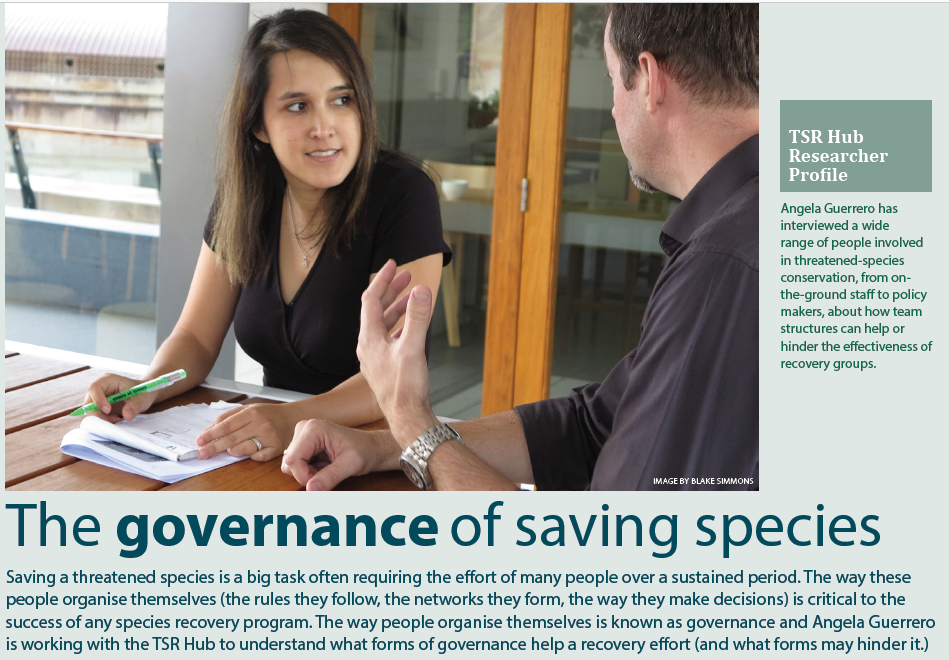
My dissertation work investigated the effectiveness of bottom-up governance approaches. This work was published in 2015. In 2016 I worked with the National Environmental Science Programme’s Threatened Species Recovery Hub (TSR) to examine recovery efforts across Australia in an effort to identify the barriers and enablers of successful collaborative recovery efforts. In my recent work at the Stockholm Resilience Centre, I investigated wildfire response networks to identify whether, and how, structure of collaborative interactions influence the effectiveness of the response.
Key publications:
Guerrero A.M., Bodin Ö., Nohrstedt D., Plummer R., Baird J., Summers R. (in review) Collaboration and individual performance during disaster response.
Bodin Ö., Guerrero A.M., Nohrstedt D., Baird J., Summers R., Plummer R. (in press) Collaboration, task engagement and response effectiveness during wildfire disasters. Public Administration Review
Guerrero A.M., Sporne I., McKenna R., Wilson K.A. (2021) Evaluating institutional fit for the conservation of threatened species. Conservation Biology 35(5):1437-14-50. https://doi.org/10.1111/cobi.13713
Clement S., Guerrero A.M., and C. Wyborn. (2019) Understanding effectiveness in its broader context: methodologies for evaluating collaborative conservation governance. Society and Natural Resources. 1-22 https://doi.org/10.1080/08941920.2018.1556761
Guerrero, A.M., Ö. Bodin, R.R.J. McAllister, K.A. Wilson (2015). Achieving social-ecological fit through bottom-up collaborative governance: and empirical investigation. Ecology and Society. http://www.ecologyandsociety.org/vol20/iss4/art41/
Guerrero, A. M., R. R. J. McAllister & K.A Wilson (2015). Achieving cross-scale collaboration for large scale conservation initiatives. Conservation Letters 8(2): 107-117. http://dx.doi.org/10.1111/conl.12112
Guerrero, A. M., R. R. J. McAllister, J. Corcoran, and K. A. Wilson. (2013) Scale Mismatches, conservation planning, and the value of social-network analyses. Conservation Biology 27:35-44. doi: 10.1111/j.1523-1739.2012.01964.x
 angelaguerreroresearch.com